|
|
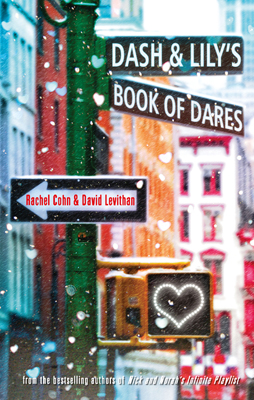
I want to talk about Dash & Lily’s Book of Dares first because I read it first and because it made me angrier/more annoyed so I probably have more to say about it.
I did not like Dash & Lily’s Book of Dares. I found it readable-ish and compelling-ish just enough to pull me through, but otherwise really kind of lazy and smug? The writing was good enough and there was some nice placemaking but the characters were both pretty bland and well, I wouldn’t normally say cliché because I think it’s a cheap criticism generally, except for how Dash really was and Lily verged real close to it. The entire book somehow managed to bemoan hipsterism while having two leads who would be classified by the general public as being kind of hipstery*. It wasted my time on multiple tirades about how terrible everything about Christmas is — boring! done a million times! who cares! — and made the character that likes Christmas sound like an infant? And even in the end, I don’t understand why these characters end up together/feel that they only do so because they just don’t know each other at all. Dash is a whiny, angsty pain in the ass who hates Christmas fundamentally. Lily is a mollycoddled crybaby optimist who thinks Christmas is the greatest. Neither of them change significantly enough to warrant mention and yet somehow I’m supposed to believe they’ll ever get along because they… saved a baby kind of and got arrested? I just do not get it.
Plus the little things! There is a fundamental misunderstanding of Pixar movies from both Dash and Lily in totally different ways and it ends up reading like neither Levithan nor Cohn has ever actually watched one, which is a shame as it’s some of the best storytelling going on in pop culture right now. Cohn calls Hermione Granger, Hermione Potter which is so egregious on her part and the part of every single person who let it go through to print that I cannot even start talking about.

I’m going to be totally real and say that I did not really enjoy Let It Snow but that after how irritating Dash & Lily was it was a straight-up relief.
I liked Maureen Johnson’s section/story quite a bit. I thought the Flobie stuff was really funny/cute and Jubilee’s a good narrator. She’s funny and a little bit clever and a lot honest, which makes for a nicely entertaining narrative. I thought the rambling about Jubilee being a stripper’s name and the sort of shame-y talk about strippers was weird but then she cut it with a kind of vague “I don’t mind strippers!” and it felt slightly better? But then she spent a lot of time hating cheerleaders (like most of the girls in the book) and it was just such a bummer. It’s the least awful in this section though, so I’ll take that for what it is. I like Stuart and his family — especially his mom, despite her weird trying-to-get-my-son-laid vibe — even though I am so, so deeply creeped out by any teenage girl deciding to go home with a stranger? Like, get back on the train or stay at the Waffle House! Don’t get murdered!
I didn’t enjoy the other two sections even like, 1/10th as much as I like the first and that’s not saying all that much, since I wasn’t that impressed with it either. I thought John Green’s section was really, really gross and relied on so many miserable stereotypes that I don’t even really want to start. I know a lot of people really love John Green and I think that he can tell a good story, but I think that his depictions of women are often super sexist and rely heavily on that tired “I’m not like other girls” trope and his story in this collection was just rife with it. Gross, gross. Lauren Myracle’s section didn’t fare much better and I found almost every character in it unbearable. I also don’t understand the way people treat Addie? I know we all have That Friend who is super self-absorbed and dramatic, but I don’t really feel like Addie is like that? At the very least, we don’t see enough of it in the story. She’s just gone through a break-up and that’s when everyone is at their worst! And everyone around her seems deeply unsympathetic. You can say “She is always like this” as much as you want, but when your readers don’t see it and you’re in the dramatic characters point of view, we just end up thinking other characters are jerks.
Happy Boxing Day! Sorry I hate everything. Kind of. ♥
*: “Hipster” is neither a criticism nor a judgment coming from me. It’s 2013, hipster 1. has almost no meaning whatsoever, and 2. could describe pretty much every person I’ve ever met under the age of 40. I just mean, you know, people who are a little disaffected and cool while pretending they’re not trying. Everyone is trying. It’s okay, guys.

I really, really loved Eleanor & Park. Any time I read a book that’s been hyped immensely I get real, real nervous about reading it. I like liking things that other people like, but that often ends up not being the case. I don’t think it’s necessarily that I’m obstinate — though I am, extremely — or that other people don’t like good things, it’s just that hype makes things into giant towering piles of bullshit. You know how that goes.

But Eleanor & Park was totally worth the risk or, rather, wasn’t really a risk at all since it was so, so, so incredibly good.
There are a lot of elements that come together to really make the book work: Park’s wonderful family that isn’t too perfect, Eleanor’s shitty family and her refusal to let their shittiness dictate her entire existence, the push-pull of foreignness and familiarity that comes with setting the story in the semi-recent past (at least for someone of my age, I imagine the effect is very different for those too young to have ever owned a cassette tape), the emphasis on music that never feels forced or braggy, the wonderfully, agonizingly slow romance of it, the emphasis on real, honest teen sexuality, punchy, interesting language that never gets too showy, and thoughtful, complex teenaged narrators that never feel anything other than real and truthful and fully-fleshed.
I don’t know how Rowell manages to do what she does in this book so well, but if her other novels manage even three-quarters of what this one does, she’s got to be a wizard of some kind.
I got so caught up in the storytelling and the experience of the book that I didn’t even highlight hardly anything and that’s generally a really good sign? I really, really loved the moment when Park took Eleanor’s hand for the first time because it was rendered so perfectly. “He wound the scarf around his fingers until her hand was hanging in the space between them. Then he slid the silk and his fingers into her open palm. And Eleanor disintegrated.” Me too, Eleanor, me too.
I also really loved Park gathering every AA battery he could find to bring to Eleanor for her Walkman. “He emptied all his handheld video games and Josh’s remote control cars, and called his grandma to tell her that all he wanted for his birthday in November was AA batteries.” I mean, is there any better show of devotion in that moment? Wonderful.
Anyway, if you can’t tell, I loved this one and I am so, so glad that I ignored that dumb part of me that wants to avoid things that lots of other people love. It turns out that sometimes — okay, maybe often — people are pretty smart. Or whatever.
I have a lot of feelings about The Waking Dark, so let’s talk about that, eh? Spoilers! » more: the waking dark by robin wasserman
 
I really, really liked Jesse Andrews’ Me and Earl and the Dying Girl. I liked it a lot, definitely more than I expected to — I think? — and it’s one I’m glad I stumbled across on Amazon in my search for cheap Kindle books. It reminded me in a lot of ways — the good ones — of Frank Portman’s King Dork which I read around this time of year in 2009. September means stories about school to me and these are both stories that are about school and not about school in equal measure.
In fourth grade, I realized that girls were desirable. I had no idea what you were supposed to do with them, of course. I just sort of wanted to have one, like as a possession or something.
Both books are funny in similar ways, in this very specific way of young white men, that is intangible but near-visceral to me, and that makes me sometimes laugh so hard out loud that I have to put down what I’m reading and try to remember how to breathe. It is a key of phrasing, of word choice, and it’s near-impossible for me to pinpoint or draw actual line comparisons. I sat down to read King Dork again just because I wanted to be able to make clear references, but couldn’t focus on it because I kept thinking how much more I liked Me and Earl and the Dying Girl.
Did I want to get with Madison ? Yes. Of course I did. I would have given up a year of my life just to make out with her. Well, maybe a month. And obviously she would have to be doing it voluntarily. I’m not suggesting that some weird wish -granting genie would force her to make out with me in exchange for a month of my life. This entire paragraph is a moron.
Andrews’ narrator Greg is more self-aware, conscientious, and kind. He’s not perfect, but he tries very hard — perhaps initially because he wants to remain on everyone’s good side and under the radar, but ultimately because he doesn’t want to hurt people. He’s aware of his privilege, he’s aware of the class and racial differences between him and his friend Earl, he’s aware and speaks colloquially but explicitly about the importance of consent. Greg’s a good guy. And, unlike King Dork‘s Tom, he’s not obsessed with The Catcher in the Rye which is a book that, since I first read it at 12, has made me hate teenage boys, male writers, and every teacher and human being that has ever lauded it. Instead he’s obsessed with Werner Herzog for whom I have no opinion. Improvement!
“Urrrrgh.†We were silent, so I made the noise again. “Urrrrnngh.â€â€œWhat is that noise.†“Regretful polar bear.†Snort. “Polar bears are the most regretful animals in nature. Scientists do not know why this is. But they have the purest expressions of regret in the animal kingdom. Listen to how beautiful and haunting they sound: Urrrrrrrnnngh.â€
Me and Earl and the Dying Girl doesn’t have the world’s happiest ending. It’s not tied up and inspirational, but it is grounded and it is hopeful. It’s got great, funny writing and a self-aware, self-effacing narrator with a really charming, but never unbelievable narrator. It also has one of the best, most memorable teachers I’ve ever seen show up in a young adult book.
Mr. McCarthy had a look on his face of deep concern. It was definitely out of character for him and it was sort of distracting me. It was like when a dog makes a human-style face at you and you’re temporarily thrown off guard by it. You’re like, “Whoa, this dog is feeling a mixture of nostalgic melancholy and proprietary warmth. I was not aware that a dog was capable of an emotion of that complexity.â€
So, you know the drill, go buy it and read it and stuff.

Right when you were born, the tunnel was huge. You could be anything. Then, like, the absolute second after you were born, the tunnel narrowed down to about half that size. You were a boy, and already it was certain you wouldn’t be a mother and it was likely you wouldn’t become a manicurist or a kindergarten teacher. Then you started to grow up and everything you did closed the tunnel in some more. You broke your arm climbing a tree and you ruled out being a baseball pitcher. You failed every math test you ever took and you canceled any hope of being a scientist. Like that. On and on through the years until you were stuck. You’d become a baker or a librarian or a bartender. Or an accountant. And there you were. I figured that on the day you died, the tunnel would be so narrow, you’d have squeezed yourself in with so many choices, that you just got squashed.
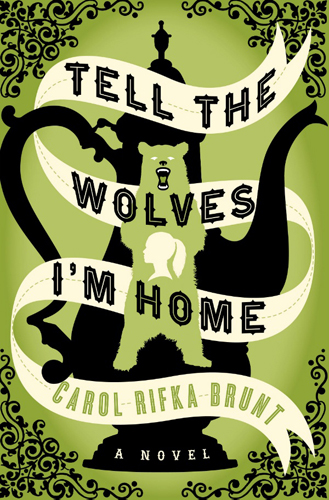 Tell the Wolves I’m Home was really very extraordinary.
I wasn’t exactly looking forward to reading this one. That’s not quite accurate, but, I mean, I wanted to read it obviously, but I was dreading it in the same way I dread reading any book that has good buzz and is well-liked. What if I’m the one that doesn’t like it? I like liking things! And I don’t care about having an unpopular opinion, but I do dread having to talk about it since it usually amounts to me going, “I DON’T KNOW, IT’S JUST NOT FOR ME.”
This time though, I had nothing to worry about because the hype about Tell the Wolves I’m Home is totally founded.
I keep trying to articulate the ways in which I found this one so pleasing and there are lots of technical reasons why — the pacing is lovely, the writing is gorgeous verging on astounding in places, the story is rich with life and feeling and emotion, and the depth with which the reader understands June is near magical — but I just keep coming back to the almost physical sensation of pleasure that happened while I was reading, a feeling like climbing into cool sheets or a warm bath or your favorite pajamas. I cried a lot while reading and it was good, hard crying that left me feeling wrung out in the best, most satisfied way. There’s magic in that kind of writing, a kind of careful sorcery of emotion and language that takes your readers apart in a way that’s satisfying and thrilling and unforgettable.
June isn’t perfect and that’s what makes her so remarkable. She’s likable and weird and funny, but she also makes bad decisions and it’s what makes her so full and human. She makes the kinds of decisions that fourteen-year-olds make and you understand them, even when you hate them or know they’re not the right ones for her to make. She’s wonderfully well-fleshed and she’s not alone, Toby and Greta are complex, complicated characters that bring vitality and life to June’s interior. Greta’s not likable and I’m not sure I’d have ever been able to treat her with the near-unfailing humanity that June does, but that’s what makes them such great characters.
I genuinely want to have tons of things to say, lots of eloquent commentary and brilliant observations, but I don’t. Tragically. Tell the Wolves I’m Home is just good. It was a good, quick read and I felt bone-deep satisfied when it was over. It deserves the hype. It’s better than the hype. Read it.
|
|